Monday, March 3, 2008

Quantum dots


When I went through the Interview on Quantum dots, programmable matter, and Wellstone (with Author Wil McCarthy by Rocky Rawstern Editor Nanotechnology Now - June 2003) I understood the intricacies of quantum dots with much of clarity and inquest.In the interview when questioned about the quantum dots McCarthy answers as follows

“Can you give our readers a brief explanation of "artificial atoms" and "quantum dots," and how they - when produced en mass - can create "programmable matter"?
A quantum dot is a device which traps electrons in a very small region of space, forcing them to behave like tiny standing waves, just as they do in atoms. An "artificial atom" is a cloud of electrons trapped in this way. Although it has no nucleus of its own, the artificial atom behaves in many ways like a real atom does. Producing large numbers of artificial atoms inside a bulk material, such as a semiconductor, will alter its properties dramatically so that, for example, it can be made to appear and behave like a metal, or an insulator. The material's color, transparency, reflectance, thermal and magnetic properties can also be altered, in real time.”

To go still more I browsed through the internet and could find many more interesting definitions and dimensions in context to quantum dots. From a very basic understanding to applications I would like to share some essences of my reading as well given the concerned urls for your further reading let me start to go further into the basics of quantum dots

“Quantum dots are small devices that contain a tiny droplet of free electrons. They are fabricated in semiconductor materials and have typical dimensions between nanometers to a few microns. The size and shape of these structures and therefore the number of electrons they contain, can be precisely controlled; a quantum dot can have anything from a single electron to a collection of several thousands. The physics of quantum dots shows many parallels with the behavior of naturally occurring quantum systems in atomic and nuclear physics. As in an atom, the energy levels in a quantum dot become quantized due to the confinement of electrons. Unlike atoms however, quantum dots can be easily connected to electrodes and are therefore excellent tools to study atomic-like properties. There is a wealth of interesting phenomena that have been measured in quantum dot structures over the past decade. This page shows a few examples from our group. The next blog will first discuss briefly the parallels between atoms and quantum dots.

Saturday, February 16, 2008

My students Nanotech info for this week

Dear students I happen to read many interesting things on Nano and one of the sample i would like to share with you all...
http://www.nanotech-now.com/
In the site an introductory stuff to beginer is presented very nicely...browse through the session and come prepared...It starts as
"Truly revolutionary nanotechnology products, materials and applications, such as nanorobotics, are years in the future (some say only a few years; some say many years). What qualifies as "nanotechnology" today is basic research and development that is happening in laboratories all over the world. "Nanotechnology" products that are on the market today are mostly gradually improved products (using evolutionary nanotechnology) where some form of nanotechnology enabled material (such as carbon nanotubes, nanocomposite structures or nanoparticles of a particular substance) or nanotechnology process (e.g. nanopatterning or quantum dots for medical imaging) is used in the manufacturing process. In their ongoing quest to improve existing products by creating smaller components and better performance materials, all at a lower cost, the number of companies that will manufacture "nanoproducts" (by this definition) will grow very fast and soon make up the majority of all companies across many industries. Evolutionary nanotechnology should therefore be viewed as a process that gradually will affect most companies and industries........"
Have the habit of going through the latest trends in nanotechnology through internet

Thursday, January 24, 2008

Size matters much that is Nano

SIZE

Let's start BIG to explain about Nano-size

A meter is about the distance from the tip of your nose to the end of your hand (1 meter = 3.28 feet). One thousandth of that is a millimeter.
Now take one thousandth of that, and you have a micron: a thousandth of a thousandth of a meter. Put another way: a micron is a millionth of a meter, which is the scale that is relevant to - for instance - building computers, computer memory, and logic devices.

Let’s go smaller to the nanometer
A nanometer is one thousandth of a micron, and a thousandth of a millionth of a meter (a billionth of a meter). Imagine: one billion nanometers in a meter.


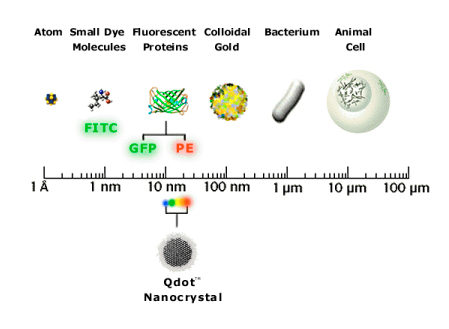
Click image for larger version. Courtesy and © Quantum Dot Corporation


Another perspective: a nanometer is about the width of six bonded carbon atoms, and approximately 40,000 are needed to equal the width of an average human hair. Another way to visualize a nanometer: 1 inch = 25,400,000 nanometers Red blood cells are ~7,000 nm in diameter, and ~2000 nm in heightWhite blood cells are ~10,000 nm in diameterA virus is ~100 nmA hydrogen atom is .1 nmNanoparticles range from 1 to 100 nmFullerenes (C60 / Buckyballs) are 1 nmQuantum Dots (of CdSe) are 8 nmDendrimers are ~10 nmDNA (width) is 2 nmProteins range from 5 to 50 nmViruses range from 75 to 100 nmBacteria range from 1,000 to 10,000 nmFor our purposes, nanometers pertain to science, technology, manufacturing, chemistry, health sciences, materials science, space programs, and engineering.

Nanotechnology is the understanding and control of matter at dimensions of roughly 1 to 100 nanometers, where unique phenomena enable novel applications. Encompassing nanoscale science, engineering and technology, nanotechnology involves imaging, measuring, modeling, and manipulating matter at this length scale. At the nanoscale, the physical, chemical, and biological properties of materials differ in fundamental and valuable ways from the properties of individual atoms and molecules or bulk matter. Nanotechnology R&D is directed toward understanding and creating improved materials, devices, and systems that exploit these new properties. From What is Nanotechnology?


Powers of 10 From 10-15 meters (a fermi), in steps of 10, to 10 -9 meters (nanometer), all the way out to 10 +16 meters (a lightyear), and finally, to 10 +23 meters (10 million light years). If you have not seen this really neat series of viewpoints, it can help to put scale into perspective! "View the Milky Way at 10 million light years from the Earth. Then move through space towards the Earth in successive orders of magnitude until you reach a tall oak tree just outside the buildings of the National High Magnetic Field Laboratory in Tallahassee, Florida. After that, begin to move from the actual size of a leaf into a microscopic world that reveals leaf cell walls, the cell nucleus, chromatin, DNA and finally, into the subatomic universe of electrons and protons." New Scientist has a great illustration on size.
Metric Prefix Table Units Conversion Tool 1 Units Conversion Tool 2

Nanotechnology - impressions

What is Nanotechnology?
Nanotechnology is the act of purposefully manipulating matter at the atomic scale, otherwise known as the "nano-scale." Coined as "Nanotechnology" in a 1974 paper by Norio Taniguchi at the University of Tokyo, and encompassing a multitude of rapidly emerging technologies, based upon the scaling down of existing technologies to the next level of precision and miniaturization. Taniguchi approached nanotechnology from the 'top-down' standpoint, from the viewpoint of a precision engineer. Foresight Nanotech Institute Founder K. Eric Drexler introduced the term "nanotechnology" to the world in 1986, using it to describe a 'bottom-up' approach. Drexler approaches nanotechnology from the point-of-view of a physicist, and defines the term as "large-scale mechano-synthesis based on positional control of chemically reactive molecules." Broadly speaking however, Answers differ depending on who you ask, and their background.
It uses a basic unit of measure called a "nanometer" (abbreviated nm). Derived from the Greek word for midget, "nano" is a metric prefix and indicates a billionth part (10-9). There are one billion nm's to a meter. Each nm is only three to five atoms wide. They're small. Very small. ~40,000 times smaller than the width of an average human hair. One aspect of nanotechnology is all about building working mechanisms using components with nanoscale dimensions (MNT), such as super small computers (think bacteria-sized) with today's MIPS capacity, or supercomputers the size of a sugar cube, possessing the power of a billion laptops, or a regular sized desktop model with the power of trillions of today's PC's. Some of the most promising potential of nanotechnology exists due to the laws of quantum physics. Quantum physics laws take over at this scale, enabling novel applications in optics, electronics, magnetic storage, computing, catalysts, and other areas. Regardless of the diverse opinions on the rate at which nanotechnology will be implemented, people who make it a habit of keeping up with technology advances agree on this: it is a technology in its infancy, and it holds the potential to change everything. Read this great Introduction from the Center for Responsible Nanotechnology for a better understanding of what nanotechnology is and is not, the social and business implications, and some steps being considered to control misuse. Related and interwoven fields include, but are not limited to: Nanomaterials, Nanomedicine, Nanobiotechnology, Nanolithography, Nanoelectronics, Nanomagnetics, Nanorobots, Biodevices (biomolecular machinery), AI, MEMS (MicroElectroMechanical Systems), NEMS (NanoElectroMechanical Systems), Biomimetic Materials, Microencapsulation, and many others.